Bitcoin News Sentiment Analysis: How to Read Market Psychology and Apply It to Investing
Bitcoin news sentiment analysis is a key tool for predicting market psychology amid high volatility. This guide covers the fundamentals, latest research, and practical ways to incorporate sentiment signals into your investment decisions.

 Bitcoin News Sentiment Analysis: Research Cases and Investment Signal Applications — Cover Image
The cryptocurrency market — Bitcoin in particular — exhibits far greater volatility than traditional assets. Behind these sharp price swings, real-time news and information directly shape the psychology of market participants. Bitcoin news sentiment analysis is a technique for mechanically extracting and quantifying the collective psychology hidden within this textual information. It goes beyond simply reading the news, offering objective, data-driven market insight. In this post, we’ll explore what sentiment analysis is, how it is being researched, and what signals it can offer for your investment decisions.
Bitcoin News Sentiment Analysis: Research Cases and Investment Signal Applications — Cover Image
The cryptocurrency market — Bitcoin in particular — exhibits far greater volatility than traditional assets. Behind these sharp price swings, real-time news and information directly shape the psychology of market participants. Bitcoin news sentiment analysis is a technique for mechanically extracting and quantifying the collective psychology hidden within this textual information. It goes beyond simply reading the news, offering objective, data-driven market insight. In this post, we’ll explore what sentiment analysis is, how it is being researched, and what signals it can offer for your investment decisions.
What Is Sentiment Analysis? Measuring the Market’s “Mood”
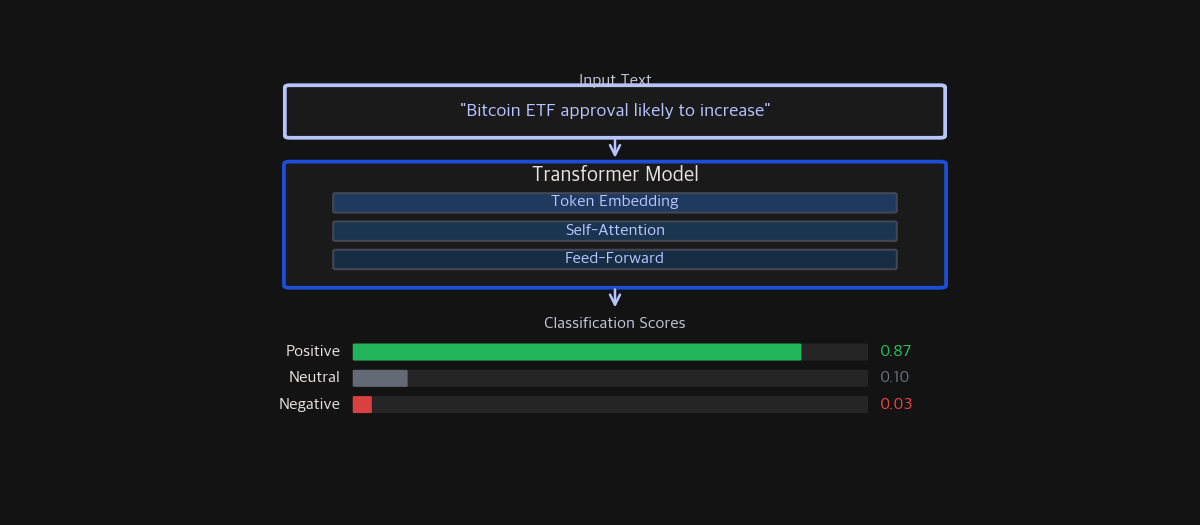
Sentiment analysis — also called opinion mining — is a natural language processing (NLP) technique in which a computer reads text data and automatically classifies the polarity of the emotions or opinions it contains. When applied to financial markets, the classification is typically divided into three categories: “positive,” “negative,” and “neutral.”
- Positive sentiment: Appears in news articles or social media posts that mention optimistic outlooks, favorable developments, technological advances, or supportive regulatory announcements.
- Negative sentiment: Derived from content that includes risk factors, tightening regulation, security incidents, or pessimistic forecasts.
- Neutral sentiment: Refers to information that conveys only facts and carries no clear emotional coloring.
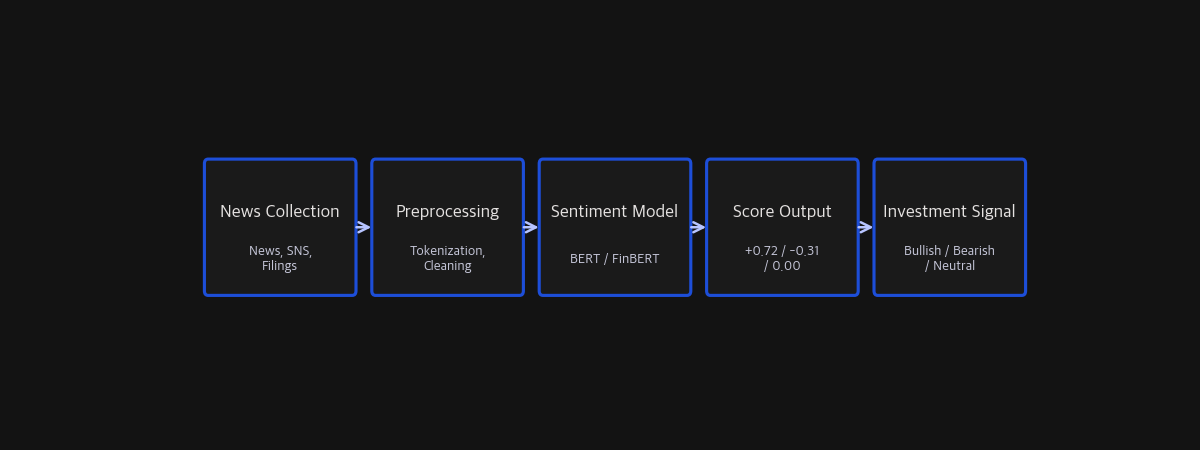
The range of texts analyzed in the Bitcoin context is quite broad. It includes articles from major crypto news outlets, official announcements from central banks and governments, research reports from financial institutions, and the opinions of key influencers on social media — especially X/Twitter and Reddit. The core role of a sentiment analysis system is to collect and analyze all of this information in real time and distill it into a single metric (e.g., a sentiment index).
Research Landscape: Sophisticated Analysis via Deep Learning
Early sentiment analysis relied on simple keyword matching — terms like “bullish,” “bearish,” “surge,” or “crash.” However, this approach struggled to accurately classify complex sentences such as “This measure creates short-term headwinds but makes the market healthier in the long run.” Recent research and industry trends have evolved to leverage deep learning models capable of understanding such nuance.
The Importance of Domain-Specific Models
Models designed to analyze general text differ from those built to analyze financial news. The financial domain contains many specialized terms — “long,” “liquidation,” “resistance level,” “FUD (fear, uncertainty, and doubt)” — that require particular care. As a result, cutting-edge research is focused on developing models trained specifically on Bitcoin and financial news data. These models understand context more deeply, improving accuracy by interpreting the same word differently depending on the surrounding sentences.
Expanding the Scope: From Prediction to Execution
Whereas earlier research focused on demonstrating the correlation between news sentiment and subsequent price movements, current trends aim to apply these findings to actual trading. For example, researchers are actively designing algorithms that interpret extreme negative sentiment scores in a given time window as buy signals, and building composite investment models that combine multiple sentiment indicators with technical indicators such as moving averages and RSI. This demonstrates that sentiment analysis is evolving from a simple reference tool into a core input for automated quantitative strategies.
Implications and Practical Applications for Individual Investors
Even retail investors who are not building advanced algorithmic trading systems can find sentiment analysis results and approaches to be useful reference tools.
1. Objectively Confirming Market Overheating or Fear
Individuals can easily be swept up by surrounding noise or their own biases. Sentiment analysis metrics quantify the overall mood of the market as a number. If all news outlets and social media platforms are showing extremely optimistic readings, this may reflect that the market has entered an overheated phase. Conversely, sustained negative sentiment may signal a state of panic. These objective indicators help you make clear-headed decisions without being swayed by FOMO (fear of missing out) or FUD.
2. Paying Attention to the “Quality” of News
Not all news carries equal influence. Understanding which types of news most powerfully affect investor sentiment is important.
- Macroeconomic / regulatory news: Interest rate decisions by major central banks, inflation data, or the announcement of concrete regulatory legislation have the strongest impact.
- Technology / ecosystem news: Major Bitcoin network upgrades (e.g., Taproot) or news of adoption by large corporations act as medium- to long-term signals.
- Market structure news: Approval or rejection of a major institutional ETF, or a listing on a top exchange, affects liquidity and confidence.
When referencing sentiment analysis, develop the habit of looking at what type of news is driving the sentiment, not just the headline-level reading.
3. Using It as One Element of a Holistic Judgment
The most important principle is not to treat sentiment analysis as an absolute buy or sell signal. It is an excellent supplementary indicator, but it is not a silver bullet. Approach it as follows:
- Cross-check it with technical analysis (chart patterns, indicators).
- Compare it against on-chain data (exchange inflows/outflows, whale wallet behavior).
- Pay close attention to the point at which sentiment indicators reverse after reaching an extreme. Market psychology often begins to turn at extremes.
Frequently Asked Questions (FAQ)
Q1: How reliable are the results of news sentiment analysis? A: They are imperfect but steadily improving. Domain-specific deep learning models show considerable accuracy, but they still have limitations when it comes to fully understanding irony, metaphor, and newly emerging internet slang. Moreover, if the news itself reports on rumors or speculation rather than facts, the analysis results can be skewed as well. It is therefore best to treat sentiment analysis as a probabilistic and trend-based indicator rather than something to trust 100%, and to cross-validate it against other data.
Q2: How can an individual investor apply this analysis directly? A: Building a professional model is difficult, but there are several publicly available services to draw on. Internationally, there are websites and paid data platforms that index cryptocurrency news and social sentiment in real time. Domestically, some financial data providers are beginning to introduce related indicators as well. To get started for free, try collecting headlines from major cryptocurrency news sources and manually classifying them as positive, negative, or neutral. This is a great way to develop intuition for market sentiment.
Q3: Is sentiment analysis only useful for short-term investing? A: No. While it is used more frequently for forecasting short-term volatility, it also provides meaningful insights for medium- and long-term investment. For example, analyzing the trend in sentiment around regulatory news over an extended period can give you a sense of a country’s policy direction. Additionally, sustained positive sentiment in news about technological development can serve as a signal reflecting the health of the ecosystem — making it valuable background knowledge when formulating a long-term HODL strategy.
Related Posts



Newsletter
Weekly Quant & Market Insights
Get market analysis, quant strategy ideas, and AI & data tool insights delivered to your inbox.
Subscribe →